

Offers
City Tours Berlin | City Tours Potsdam | Excursions
CITY TOURS BERLIN
- Glamour, glory and (delusions of) grandeur – Berlin – Tour de Horizons –
From fishing village to the fastest changing city in Europe. - Mascha Kaléko – A lyrical journey through the metropolis –
She was called the female Erich Kästner, and seen in the tradition of Heine and Tucholsky, she wrote in a joyful, ironic and at the same time melancholic tone about the life of small people and the atmosphere of Berlin in the Golden Twenties. - Liebermann in Berlin – On the trail of a master painter –
Max Liebermann, who is considered for both his work in the arts and for his political activity to be one of the most important trailblazers of modern German painting, was of particular importance for Berlin's cultural blooming in the 1920's. - Inside and Out – The Berlin Wall, the „Stasi“ and the GDR –
The most dramatic symbol of half a century of Cold War and the division of Germany was the Berlin Wall. Therefore the main focus of visitors to Berlin lies on the remnants of those days. - Hanukka and Holocaust – Jewish Life in Berlin –
Many traces of Jewish Life in Berlin have been extinguished but some still exist. - Realms, Revolutions and Republics – Berlin in the 20th century –
Berlin looks back on a history of many changes. The 20th century in particular illustrates how rapidly changes occur in this city.
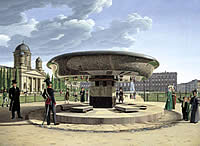 From the small, dirty and simple town on the eastern border of the Holy Roman Empire of German Nations to the residence of the Great Electors of Brandenburg, then the capital of the state of Prussia and later the center of the 2nd and the 3rd German Reich. 770 years of local history became manifest in the growth rings of the city’s buildings, urban structures and developments. These stone witnesses of passing time tell their stories of ideas, hopes, dreams and changes in the life of Berlin and the Berliners. On this tour, some of the visible and a few of the passed away layers of Berlin history will be lit and discovered at the most interesting buildings and streets.
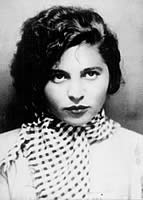 Berlin was home to Mascha Kaléko for a few luminous years before the great darkness. Her straightforward newspaper poems were written in a cheerful, ironic, and at the same time melancholic tone and reflect the living environment and atmosphere of Berlin in the Golden Twenties. We follow Kaléko's path of life and revive her impressions and thoughts once more to meet an exceptional combination of the typical Berlin impudence, heartiness, and wistfulness. She was called the female Erich Kästner, and seen in the tradition of Heine and Tucholsky, as a writer she was classified as part of a German cultural movement of the Weimar period called The New Sobriety, although she was of a different opinion about herself: Gehöre keiner Schule an
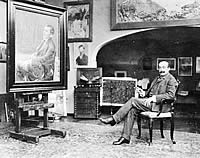 Max Liebermann's personal development is closely connected to the history of the city. He was especially significant as the co-founder of the Berlin Secession around the turn of the century and as the president of the Prussian Academy of Arts, fostering a profound cultural development in Berlin during the Golden Twenties. Well respected all over the world, showered with medals, declared an honorary citizen of Berlin, Liebermann in his later years had to live with the taunts and abuses of the Nazis. His death meant the end of a long history of the Liebermanns in Berlin - it is one more example of how the Third Reich and the Holocaust were able to smash the continuity and traces of 200 years of intellectual and industrial history once and for all. On this tour we look at the most important stations in Max Liebermann's life and make an informative and insightful visit to his two residencies: the Liebermann estate next to Brandenburg Gate and his "castle by the lake", the Liebermann Villa at Wannsee.
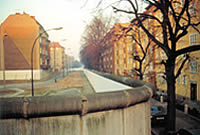 Where was the Berlin Wall? How was it perceived in the East and the West? What is the Stasi? What was life like in the GDR? This tour not only leads to the remains of the Wall and the former GDR and Stasi buildings, but also tries to give answers to questions about daily life in the split city, questions about people's attitudes towards socialism; the Stasi or the GDR and about the effects of "the wall inside".
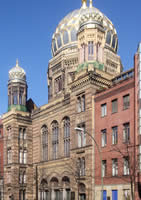 For more than 1000 years Jews have lived in Berlin. They strongly influenced and enriched life and development of a city that became the center of the invention and organization of the Holocaust. Berlin has to live up to this huge historical burden and responsibility. And at the same time it has to save and restore as much of the lost treasures as possible. This tour will guide you to the most important and impressive points of memory and renewal of Jewish Life in Berlin.
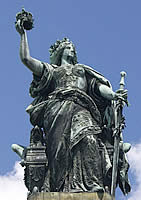 Being tossed back and forth between ideologies, Berlin continuously experienced times of prosperity and years of utter destruction. In the past century Berlin often enough lay in ruins, but the city has never stood still. Quickly the rubble was swept away and a completely new direction taken. This tour speaks of the old Kaiser Reich and various wars, of the Fuehrer and times of discreation, of dictators and democrats, of terror and separation, of world views, a vast political shift, and of the unification.
CITY TOURS POTSDAM
- Sans Souci – Friedrich II. and his Time –
Designed as a private retreat and built in record time, Sans Souci still enchants us today with images of the lifestyle and art of the friderizian rococo. - Cecilienhof – The big Three –
The last built castle of the Prussian Hohenzollern became the location of the fateful decision over what to do with a defeated Germany after World War II.
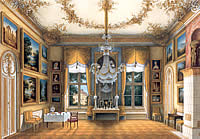 Potsdam is best known by foreign tourists for the castle "Sans Souci". We owe the most famous castle and largest park north of the alps to the Prussian king who reigned for the longest period: Friedrich II., called Friedrich the Great. He designed the construction plans himself, which shows his great interest in architecture, and he dedicated the castle to the arts. Friedrich the Great created a summer residence where he could live sans souci (without sorrows) and pursue his artistic dispositions and predilections. On this tour the most loved place of the best-known Prussian king will be visited inside and out, as well as parts of the great park.
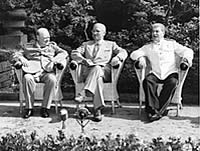 It is the castle of the last German emperor, built in the style of British country houses, for his son Wilhelm, the heir to the throne. After the banishment and expropriation of the crown prince in 1945, the rooms of the castle were rigorously redesigned. The new decoration was geared to the tastes of the participants of the upcoming Potsdam conference. The "Big Three" of world politics in the summer 1945 - Stalin, Truman, and Churchill - met in Cecilienhof castle to decide upon the future of the pacified and occupied German state. On this tour the last castle ever built by the royal family of Prussia and part of the surrounding park along the "new lake" are visited.
EXCURSIONS
We also organize longer travels in time for you and go seeking out historical traces. In combination with a timely menu and music or a dance class in costumes we design some very memorable days for your family or business.
- On the trail of Frederick the Great
Berlin – Potsdam – Rheinsberg – Neuruppin – Küstrin – Kunersdorf – Neuhardenberg – Königs Wusterhausen. A journey through the stations of the eventful life of the most famous king of Prussia. 3-6 day bus tour, different routes possible. - Louises and Legends
Oranienburg & Paretz
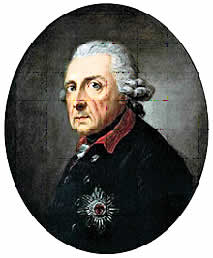 Frederick II, called Frederick the Great, is one of the most multifaceted figures of European history. In the year 2012 we celebrate his 300th birthday and take this as an occasion and invitation to take a more detailed look at his personality and his works. Under the rule of Frederick the Great, Berlin and Prussia proved to be a center of enlightenment and extensive building activities. On this excursion we encounter various excellent examples of architectural creations and the landscape designs of those monarchistic times. Many of the edifices were built in his own new and unique style – the Frederician Rococo. However, he did not only make a name for himself as an architect and builder, he was also renowned as a philosophical mind, a visionary strategist, an adventurous son of the contrary Soldier King, an engaged art lover and art patron, and much more. Even today his personage is subject to a controversy among academics, there is no consensus about the evaluation of this versatile historical character. Starting in Berlin and its many representative Frederician buildings, and continuing on to Potsdam’s carefree Prussian Versailles and other castles, the life of Frederick the Great unfurls before us. We will visit Rheinsberg, where Frederick spent joyful years, filled with music, philosophy and poetry. In the garrison town of Neuruppin we come across his military career and command. In Küstrin (Poland) we meet the trauma of his youth - the execution of his friend Hermann Katte…
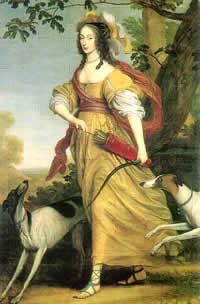 This tour traces the stories of two fascinating historical figures of Prussia and views the centers of their life and work. The first, Louise Henriette of Nassau, was an Electress of Brandenburg and wife to the Great Elector, Frederick William. She acted as the political adviser of her spouse, and was described as a pragmatist. She managed to make an alliance with Poland in exchange for the Polish recognition of Prussia as a Brandenburg province. Only a few Electresses had been allowed so much political influence. The second figure was wife of king Frederick William III of Prussia and her life was intimately connected with the dramatic incidents in the struggle against Napoleon Bonaparte. Louise of Mecklenburg-Strelitz became known for her beauty, charm and unconstrained manners, and made it her business to be aware of affairs of state. Already well-loved by her subjects, a meeting with Napoleon in Tilsit caused Louise to become revered as "the soul of national virtue". After her early death at the age of thirty-four a cult eventually surrounded Louise. She became associated with the "ideal" feminine attributes, and a myth and symbol for the rise of Prussia.
And many more...